We may earn a commission if you buy through links on this page, at no extra cost to you. How this works
Derila Ergo: A contoured memory foam pillow with side wings and a removable, machine-washable cover.
See Derila Ergo on the official site60-day money-back guarantee
What is the best pillow firmness for side sleepers?
Medium-firm is the best starting point for most side sleepers, because it fills the gap between ear and shoulder and holds its shape all night.
Two words get mixed up. Firmness is how much a pillow pushes back when you press it. Loft is how tall it is. Side sleepers need both right.
Here’s an example. A wide-shouldered person needs more height than a narrow-framed one. A small pilot study of 15 young adults found neck muscles worked least, and comfort scored highest, when pillow height matched about one shoulder width. It was small, so treat it as a clue. For the height side of this, see our guide to pillow height for side sleepers.
Soft, medium, medium-firm or firm: how do they compare?
Each firmness level suits a different body and position, and side sleepers usually land in the middle or firmer end.
| Level | Feel | Typical loft | Best for |
|---|---|---|---|
| Soft | Sinks easily, hugs the head | Often flattens low | Stomach sleepers; some back sleepers |
| Medium | Gives, then supports | Low to mid | Back sleepers; narrow-framed side sleepers |
| Medium-firm | Gives a little, holds shape | Mid to high | Most side sleepers |
| Firm | Barely compresses | Mid to high | Side sleepers with broad shoulders |
Soft pillows
A soft pillow suits stomach sleepers best, since they need a thin, squashy pillow. Under a side sleeper’s head it often flattens, which can leave the neck bent down toward the mattress.
Medium and medium-firm pillows
Medium suits back sleepers and slim side sleepers, while medium-firm suits most side sleepers. The pillow gives a little, then stops, so your head stays level.
Firm pillows
A firm pillow suits broad shoulders because it doesn’t sink. On a narrower frame it can feel too high and push the head upward.
Does a firm pillow help with neck pain?
A firm pillow can feel better for a sore neck because it keeps your head from sinking sideways, but it isn’t automatically the right choice.
Why firm support can feel better
Firm support holds the head steady. A meta-analysis of pillow trials found rubber pillows were linked to less neck pain in people with chronic neck pain. It also suggested the pillow’s shape and height matter for neck alignment.
When firm is too much
A systematic review of five studies found no pillow type, whether latex, foam or standard, was clearly better. So a firm pillow that’s too tall may just swap one problem for another. This is comfort advice, not a treatment. For more, see pillows for a sore neck.
How do I test pillow firmness at home? (press-test checklist)
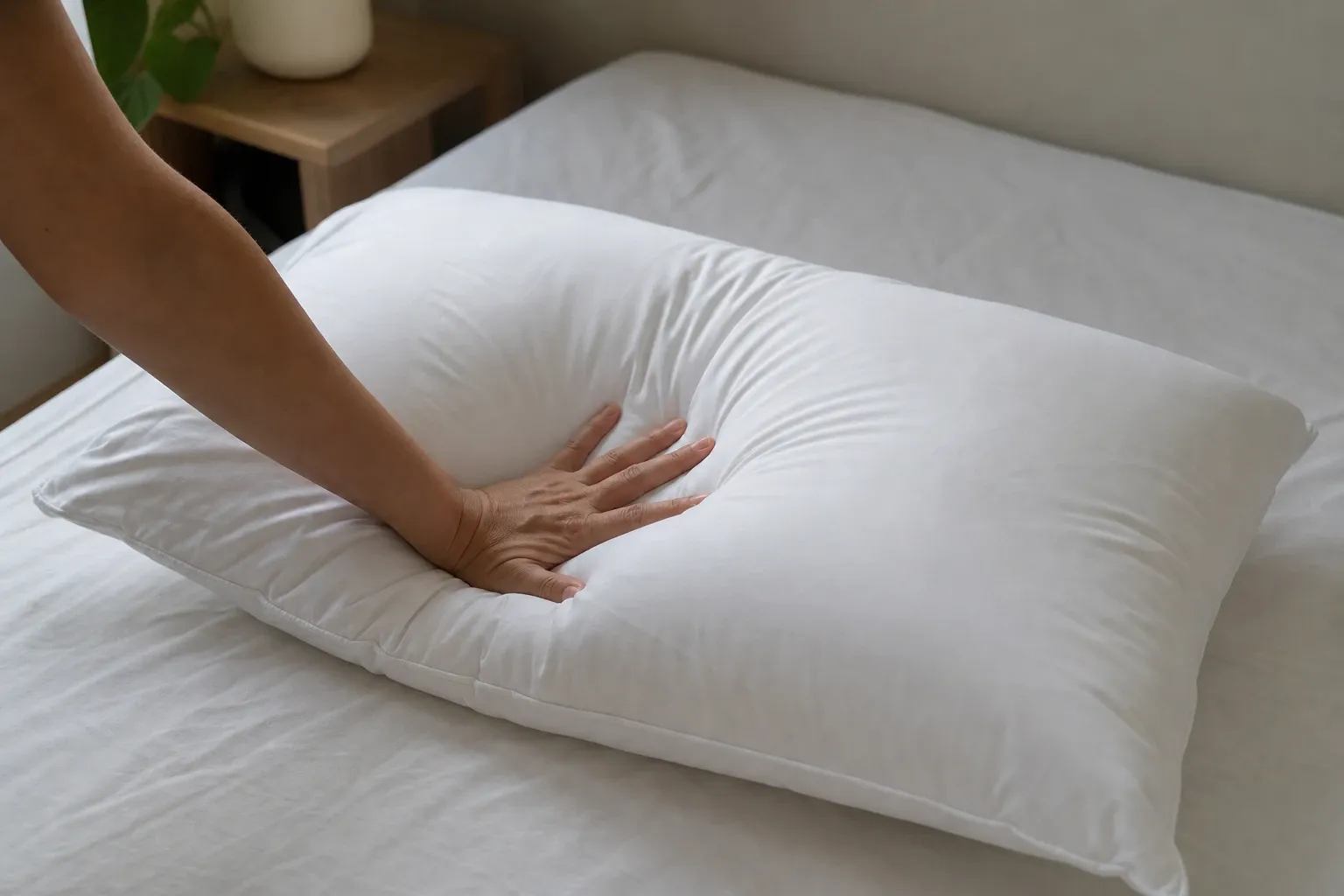
A two-part test works: press the pillow with your palm, then lie on your side for several minutes and check your alignment.
- Palm press. Push down. A good side pillow sinks a little, then pushes back. Fail: your hand reaches the bottom, or it stays dented.
- Nose line. Lie on your side for five minutes. Your nose should point in line with the middle of your chest. Fail: it points up or down.
- Ear-to-shoulder gap. The pillow should fill it without lifting your head. Fail: a gap remains, or your head tips up.
- Shoulder pressure. Your lower shoulder should feel free. Fail: it’s pinched or pushed up.
- Neck tilt. Have someone look from behind. Your neck should look level.
How can I tell if my pillow is too firm, too soft or the wrong height?
Your pillow is too firm if your head tilts up, and too soft if your head sinks and your neck bends down.
- Too firm: head tips upward, the top shoulder hikes up, tightness on the upper side of the neck.
- Too soft: head sinks, neck bends down, you keep folding or bunching the pillow.
- Wrong height: a gap under the neck, or a tilt even when firmness feels fine.
Quick tip: Try a thinner or thicker pillow, or fold a towel under a low one. If your pillow has removable layers, add or take one out.
Contour and memory foam pillows for side sleepers
A contour pillow is shaped with a dip for the head and a raised edge for the neck, and memory foam is the soft-but-slow-to-spring foam often used.
Side wings or a raised edge can help fill the shoulder gap. Cooling covers and hypoallergenic labels are maker claims, so check what the cover is made of and whether it washes. Pick a size by body width: standard, queen or king, where wider pillows suit broad shoulders or restless sleepers.
Derila Ergo is one example. The maker says it’s contoured memory foam with front support wings and a cooling cover. The standard size is 54 x 36 x 12 cm. The maker hasn’t published a study of Derila Ergo itself. Compare options in our contour pillow guide and the cervical pillow round-up.
How long is the break-in and when should I replace the pillow?
Give a new firm pillow a week or two to feel familiar, and stop if your pain increases.
A foam pillow shipped vacuum-packed needs time to expand. The maker says to leave Derila Ergo 6 to 8 hours after unpacking.
Replace a pillow when it’s lumpy, permanently flat, or doesn’t spring back. Fluff, air and wash it as its label says to help it last. See when to replace pillows and our how to choose a pillow method.
When is a sore neck a reason to see a doctor?
See a doctor if neck pain lasts beyond a week or two, or comes with numbness, tingling, weakness, injury or severe headaches.
MedlinePlus lists these signs as reasons to get checked. A pillow is a comfort choice. It doesn’t replace professional care.
Snoring, gasping or daytime sleepiness also deserve a doctor’s visit, as the NHLBI describes.
Where to go next for side-sleeper pillows
Firmness is one half of the choice for side sleepers; the full picture is in best pillows for side sleepers.
If you want the height half, read best pillow height for side sleepers. For neck soreness, see side sleeper neck pain pillows. The healthy sleep pillows hub ties the rest together.
If a contour pillow is on your list, check the current Derila Ergo price and return terms on the official site. The maker advertises a 60-day guarantee, with conditions: return shipping isn’t refunded, and items must come back in original packaging.
See Derila Ergo on the official site60-day money-back guarantee
Questions readers ask
Is a medium-firm pillow better than a firm one for side sleepers?
For most side sleepers, yes. Medium-firm gives a little then holds its shape. Firm can suit broad shoulders but may feel too high on narrower frames. Use the press test: your nose should line up with your chest’s middle.
What is the best soft pillow for side sleepers?
A soft pillow works for a side sleeper only if it’s thick enough not to flatten. Check that your ear-to-shoulder gap is filled and your neck isn’t bending down. If it flattens, try medium-firm or add a folded towel.
Do I need a different pillow if I switch between side and back sleeping?
Not always. Side sleeping needs a taller pillow, and back sleeping a lower one. A medium-firm pillow with a contoured shape, higher on one edge, can cover both. Combination sleepers should test both positions for several minutes each.