We may earn a commission if you buy through links on this page, at no extra cost to you. How this works
Derila Ergo: A contoured memory foam pillow with side wings and a removable, machine-washable cover.
See Derila Ergo on the official site60-day money-back guarantee

Why put a pillow between your knees when you sleep on your side?
A side sleeping knee pillow fills the space between your thighs and knees, so your top leg doesn’t drop forward and twist your hips.
Picture a side sleeper with wide hips. Without a pillow, the top leg slides down toward the mattress. The pelvis rolls and the low back follows. The pillow holds that leg up.
It also keeps your knees and ankles from pressing on each other. Some people find this more comfortable if they get hip or lower back aches, or sciatica-type discomfort (pain that runs from the low back down a leg). It’s a comfort aid, not a treatment. We couldn’t find a study on this, so treat it as a common-sense tip that many people like.
Back sleepers can use one too. Put it under the knees. It also suits pregnancy comfort, which we cover below.
Knee pillow or body pillow: which shape fits you?
A knee pillow is the simplest choice, and a body pillow is the better fit if you also want support for your arm, chest and back.
Contoured knee pillows
A contoured knee pillow has a curved cut-out that hugs the inner thigh. It suits people who want a small, neat pillow that stays put. Some come with a strap (a band that holds it on your leg) so it doesn’t slip out.
Straight or short wedge pillows
A straight or wedge-shaped pillow is a basic block, sometimes angled. It suits side sleepers with narrow frames and anyone who moves a lot, since it’s easy to shift. For wedges used elsewhere, see our page on wedge pillows for adults.
Full-length body pillows
A full-length body pillow runs from shoulder to ankle. You hug the top and clamp the bottom between your legs. It gives arm and chest support, and many people like it in pregnancy.
C-shaped and U-shaped body pillows
C- and U-shaped pillows wrap around you, so they stay in place better. They’re bulky, though. If you share a bed, they can take up a lot of room, so measure your mattress first.
What size and thickness should I choose?
Your pillow should fill the gap from inner thigh to knee so your hips stay level. For most adults that means about 4 to 6 inches thick.
Matching thickness to hip and shoulder width
Broader hips or shoulders usually need a thicker pillow, around 6 inches. Narrow frames often do well with about 4 inches.
Quick test: lie on your side with the pillow in place and have someone look from behind. Your top knee should sit level with your hip, not tilted down or hiked up.
Length and height guidance
For a body pillow, think shoulder to ankle. That’s roughly 48 to 60 inches for adults. A knee pillow only needs to be wide enough to cover from the inner thigh to just past the knee.
Memory foam, cotton, millet or fiberfill: which material is best?
Memory foam suits you if you want a firm, stable pillow, while cotton or fiberfill suit you if you want something soft you can squash.
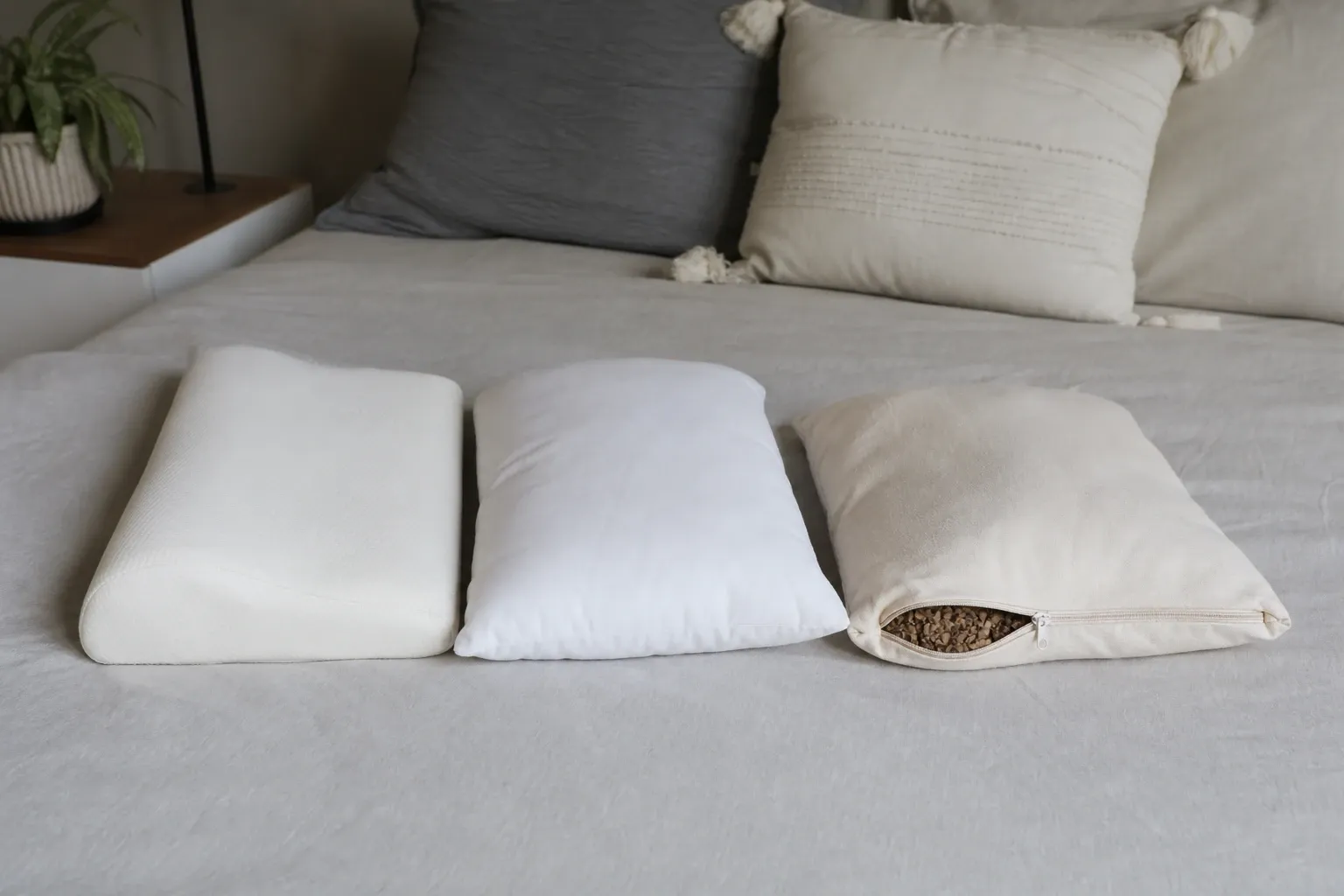
- Memory foam: contouring and firm. It can feel warm.
- Cotton or fiberfill: softer and easy to reshape. It may flatten sooner.
- Millet hulls and similar: adjustable and heavier. They may rustle when you move.
Firmness matters for stability. A pillow that’s too soft collapses, and your knee drops. A very hard one can feel like a brick. If you have sensitive skin, look for a removable cover you can wash. Makers often use cooling covers or “hypoallergenic” labels. Those are the maker’s claims, so read what’s actually stated. Our guide to hypoallergenic pillows shows what to check.
How do I pair a knee or body pillow with my head pillow?
Pair them so your head pillow fills the space from ear to shoulder, which keeps your neck level with your body while your leg pillow keeps your hips level.
Broader shoulders need a higher head pillow (its loft). A contoured pillow with side support can help. Our guide to pillow height for side sleepers goes deeper.
| Body build | Leg pillow thickness | Head pillow loft |
|---|---|---|
| Narrow shoulders and hips | About 4 in | Lower to medium |
| Average build | About 4 to 5 in | Medium |
| Broad shoulders and hips | About 6 in | Higher |
| Broad shoulders, narrow hips | About 4 to 5 in | Higher |
These are rules of thumb, not measured standards. Adjust by feel and the sideways test.
One possible head-pillow partner is the ergo memory foam pillow. It’s a contoured memory foam pillow with front support wings and a removable, machine-washable cooling cover. The maker says it supports side, back and stomach sleepers. The standard size is 54 x 36 x 12 cm (about 4.7 in high). The maker hasn’t published a study of it. Our pillow guide for side sleepers compares other options.
Check the current price and return terms on the official site.
See Derila Ergo on the official site60-day money-back guarantee
How much do they cost and how do I keep them clean?
Knee pillows usually cost the least, body pillows sit in the middle, and premium foam costs the most, though prices vary by brand and shop.
Look for a removable cover. Wash the cover regularly, following the label. Air the foam out instead of soaking it. Our guide on cleaning pillows by fill type has the steps.
Replace the pillow when it flattens or loses its shape. If your knee drops again, it’s done its job. See when to replace pillows.
How long until it feels comfortable, and who should check with a doctor?
Give a new knee pillow a week or two to feel normal, since your body is getting used to a new position.
If you’ve had surgery, follow your surgeon’s advice on how to position your legs. Don’t swap it for a pillow plan.
Ongoing hip, back or neck pain, or numbness, tingling or weakness in an arm or leg, calls for a doctor. MedlinePlus lists signs that need medical advice, such as pain that doesn’t improve within a week. A pillow can make sleep more comfortable, but it shouldn’t replace care.
Where does this fit in choosing a side-sleeping setup?
A leg pillow is one half of a side-sleeping setup, and your head pillow is the other half. Start with our guide to the best side pillow for side sleepers, then fine-tune height with pillow height for side sleepers. For the wider picture, see our healthy sleep pillows hub.
Questions readers ask
Can I use a knee pillow if I sleep on my back?
Yes. Many back sleepers place a pillow under their knees because it feels more relaxed. Pick one thick enough to lift the knees slightly without forcing them. If you also move onto your side, slide it between your knees.
Should the pillow go between knees or thighs?
Place it so it fills the gap from inner thigh down to the knee. A pillow only at the knees can leave the thigh dropping. Use the sideways test: your top knee should sit level with your hip.
How do I stop the pillow from slipping out?
Try a contoured knee pillow, a model with a strap, or a C- or U-shaped body pillow that wraps around you. A slightly firmer pillow also grips better. Soft, small pillows slide out more easily when you turn over.