We may earn a commission if you buy through links on this page, at no extra cost to you. How this works
Derila Ergo: A contoured memory foam pillow with side wings and a removable, machine-washable cover.
See Derila Ergo on the official site60-day money-back guarantee

What height should a side sleeper’s pillow be?
A side sleeper’s pillow should be about as tall as the gap between your ear and the outer tip of your shoulder. For most adults that lands around 10 to 15 cm once the pillow has settled under your head.
Height is called loft. It’s measured in cm, and what counts is the height under your head, not the height of the pillow on a shelf.
The one-line rule: fill the ear-to-shoulder gap
Fill the gap between head and mattress so your nose lines up with the middle of your chest. If your gap is 13 cm, look for a pillow that settles to about 13 cm.
A small 2025 lab study of nine people tested foam pillows from 8 to 14 cm and tied the best height to shoulder width. It’s small, but it fits the rule: wider shoulders need more height.
Why side sleeping needs more height than other positions
Side sleeping needs more height because your shoulder holds your body off the mattress, which leaves a wide gap under your head. On your back that gap is small, so a lower pillow works.
Picture a wide-shouldered person on a firm mattress. A thin pillow lets their head drop toward the bed, and the neck bends sideways all night.
Flat or raised? For side sleeping, neither extreme. Go for the height that keeps your head level.
How do I measure my ear-to-shoulder gap?
You measure the gap by sitting against a wall and measuring from your ear to the outer tip of your shoulder. It takes two minutes and a ruler.
Step by step with a wall and a ruler
- Sit or stand with your back and head against a wall. Relax your shoulders.
- Look straight ahead, chin level.
- Have someone hold a ruler flat from the middle of your ear sideways to the line of your shoulder tip.
- Write down the number in cm.
- On a soft mattress that lets your shoulder sink, subtract 1 to 3 cm. On a firm one, subtract nothing.
Quick tip: Measure twice, on different days. Posture changes the number a little.
Worked example: three body sizes
A body’s size sets the starting number. These are rough starting points, not rules.
| Build | Ear-to-shoulder gap | Firm mattress | Soft mattress |
|---|---|---|---|
| Narrow shoulders | about 10 cm | about 10 cm | about 8 to 9 cm |
| Average | 12 to 14 cm | 12 to 14 cm | 10 to 12 cm |
| Broad | 15 cm or more | 15 cm or more | 12 to 14 cm |
Head weight and body size shift things slightly, so treat the result as a first guess.
Pillow height calculator for side sleepers
The height finder below turns your shoulders and mattress into a target loft range in cm. Use it as a starting range, then confirm it with the towel test below.
Pillow height finder for side sleepers
Three quick questions turn your shoulders and mattress into a starting pillow height. It's a starting point, not a prescription.
See a doctor before changing pillows
Numbness, tingling, weakness, pain after an injury or pain that isn’t improving are reasons to get checked first. MedlinePlus lists when to contact a doctor. A pillow is a comfort choice, not a treatment.
Start at about 8 to 9 cm
Your shoulder sinks into a soft mattress, so a narrow-shouldered side sleeper needs only a low to medium pillow. If the pillow you buy has a soft fill (down, feather or fibre), pick 1 to 2 cm taller, because it settles. Then check it with the folded towel test above.
Start at about 9 to 10 cm
A medium mattress lets your shoulder sink a little, so aim just under your gap. If the pillow you buy has a soft fill (down, feather or fibre), pick 1 to 2 cm taller, because it settles. Then check it with the folded towel test above.
Start at about 10 cm
On a firm mattress your shoulder stays on top, so match your full ear-to-shoulder gap. If the pillow you buy has a soft fill (down, feather or fibre), pick 1 to 2 cm taller, because it settles. Then check it with the folded towel test above.
Start at about 10 to 12 cm
A soft mattress takes 1 to 3 cm off what you need, so aim a little under your gap. If the pillow you buy has a soft fill (down, feather or fibre), pick 1 to 2 cm taller, because it settles. Then check it with the folded towel test above.
Derila Ergo is 12 cm tall at its standard size, which sits inside this range. Check the price and the return terms on the official site.
See Derila Ergo on the official site60-day money-back guarantee
Start at about 11 to 13 cm
A medium mattress takes a little off your gap, so aim for the middle of the range. If the pillow you buy has a soft fill (down, feather or fibre), pick 1 to 2 cm taller, because it settles. Then check it with the folded towel test above.
Derila Ergo is 12 cm tall at its standard size, which sits inside this range. Check the price and the return terms on the official site.
See Derila Ergo on the official site60-day money-back guarantee
Start at about 12 to 14 cm
On a firm mattress, match your full gap. If the pillow you buy has a soft fill (down, feather or fibre), pick 1 to 2 cm taller, because it settles. Then check it with the folded towel test above.
Derila Ergo is 12 cm tall at its standard size, which sits inside this range. Check the price and the return terms on the official site.
See Derila Ergo on the official site60-day money-back guarantee
Start at about 12 to 14 cm
Broad shoulders need height, but a soft mattress lets your shoulder sink, so you need less than your full gap. If the pillow you buy has a soft fill (down, feather or fibre), pick 1 to 2 cm taller, because it settles. Then check it with the folded towel test above.
Derila Ergo is 12 cm tall at its standard size, which sits inside this range. Check the price and the return terms on the official site.
See Derila Ergo on the official site60-day money-back guarantee
Start at about 14 to 15 cm
Broad shoulders on a medium mattress need a tall pillow. A firm, high-loft or adjustable pillow is the easiest way to get there. If the pillow you buy has a soft fill (down, feather or fibre), pick 1 to 2 cm taller, because it settles. Then check it with the folded towel test above.
Start at about 15 cm or more
On a firm mattress, broad shoulders leave a big gap. Look for a high-loft or adjustable pillow and test it with a folded towel. If the pillow you buy has a soft fill (down, feather or fibre), pick 1 to 2 cm taller, because it settles. Then check it with the folded towel test above.
Start from your measured gap
Measure your ear-to-shoulder gap, take 1 to 3 cm off for a soft mattress, and test it with the folded towel method above.
A pillow that compresses a lot, like soft feathers, should be bought a little taller than your target, because it will settle lower.
How can I tell if my pillow is too high or too low?
You can tell by how your head and neck sit when you lie on your side: a neck that bends up or down means the height is off. A photo from behind makes it easy to see.
Signs it is too high
- Your head tilts upward and your neck bends sideways.
- Your lower shoulder feels pushed up.
- The arm under the pillow goes numb or tingly.
Signs it is too low
- Your head drops toward the mattress.
- The muscles at the top of your neck feel stretched.
- Your face points down toward the bed.
The folded towel test
The folded towel test adjusts your current pillow in 1 to 2 cm steps before you buy anything. Add or remove a folded towel under the pillow, and give each setting a few nights.
Ask someone to photograph you from behind while you lie down. Your nose and breastbone should sit roughly level.
If you want a shaped foam option, Derila Ergo is a contoured memory foam pillow with front support wings. It measures 54 x 36 x 12 cm, and the maker says its cover helps keep it cool and that its materials are hypoallergenic. Its 12 cm height sits inside the typical range, though your own gap decides whether it fits.
Does mattress softness change the pillow height I need?
Yes, mattress softness changes the height you need, because a soft mattress lets your shoulder sink and a firm one doesn’t. The deeper the shoulder sinks, the lower the pillow should be.
Example: a broad-shouldered sleeper with a 15 cm gap who sleeps on a soft mattress may only need 12 to 13 cm. The same person on a firm mattress needs the full 15 cm.
Recheck your height whenever you change mattress. Shoulder width also changes how far you sink, so a heavier, broader person sinks differently from a lighter one.
Should a side sleeper choose a soft or firm pillow?
A side sleeper does best with a medium-firm pillow, because a soft one squashes down and loses the height you chose. Firmness is what keeps your loft steady through the night. Our guide to pillow firmness for side sleepers goes deeper.
Thick pillows and high loft: when they help
A high loft pillow helps broad-shouldered people and those on firm mattresses. A thick pillow isn’t the same thing: thick can mean soft and fluffy, which sinks to a low loft. Judge the settled height, not the look.
High loft isn’t for everyone. A narrow-shouldered sleeper on a soft bed can end up with the head tilted up.
Foam, feathers, down and fibre compared
| Filling | Holds its height | Adjustable |
|---|---|---|
| Foam | Well | Usually not |
| Feathers | Poorly, needs fluffing | Somewhat |
| Down | Poorly, very soft | Somewhat |
| Fibre | Moderately, flattens over time | Sometimes |
In a week-long field study of 106 side sleepers, rubber (latex) pillows did better than people’s own pillows for waking neck pain, and the authors didn’t recommend feather pillows.
Do contoured pillows help?
Contoured pillows aren’t reliably better than ordinary ones, so fit matters more than shape. That same study found no advantage for a foam contour pillow over regular-shaped ones. A review of chronic neck pain trials found limited evidence, with no pillow type clearly best. Another review suggested cervical alignment in side lying may depend more on pillow shape and height than on the filling. The maker hasn’t published a study of Derila Ergo itself.
Chiropractor recommendations vary, so we can’t name one pillow. The consistent advice is to match height to your shoulder gap.
Check the current Derila Ergo price and the return terms on the official site. The maker advertises a 60-day guarantee: you have 60 days from receiving the order, the item must come back undamaged in its original packaging after you fill in a return form, and shipping costs aren’t refunded.
See Derila Ergo on the official site60-day money-back guarantee
What about back and stomach sleeping?
Back sleepers need a lower, medium-loft pillow, and stomach sleepers need a very thin one or none. Combination sleepers should aim for medium height.
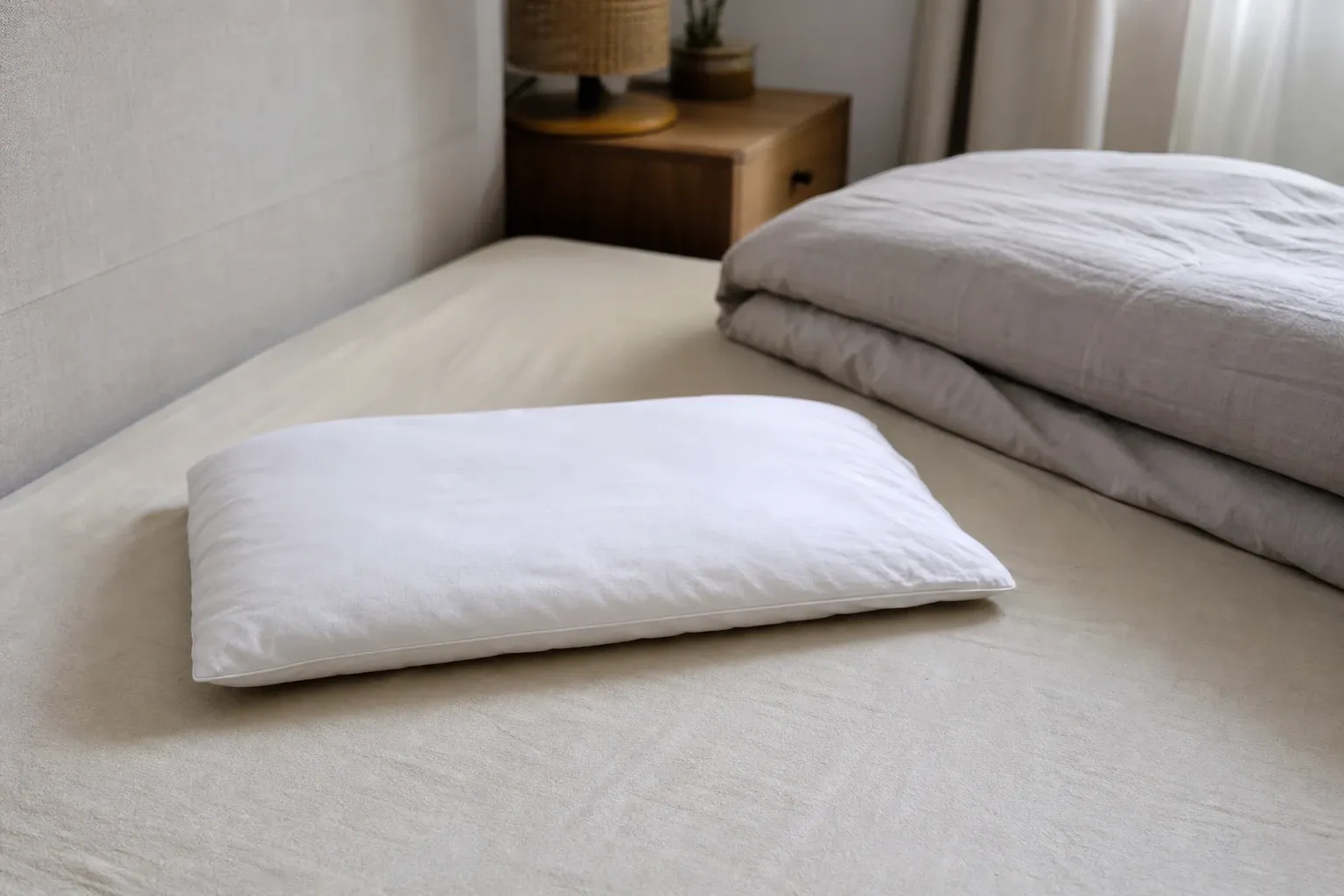
Back sleepers need a lower pillow
Back sleeping leaves a small gap under the head, so a lower pillow keeps the chin from tucking toward the chest. See our pillows for back sleepers page.
Where to put your arms if you sleep on your stomach
If you sleep on your stomach, keep your arms by your sides or under the pillow, not overhead. Overhead arms can add to shoulder discomfort. Use a very thin pillow or none.
Which sleeping position is the unhealthiest?
Stomach sleeping is commonly seen as the hardest position on the neck, because it twists the head to one side for hours. No position is harmful for everyone, so choose the one that’s comfortable and supported.
When is a stiff neck worth seeing a doctor about?
See a doctor if neck pain lasts more than a week or two, or comes with numbness, tingling, weakness or an injury. A pillow change can improve comfort, but it isn’t a treatment for neck pain.
MedlinePlus lists self-care steps and when to contact a doctor, including arm or hand weakness and pain after an injury.
Snoring, gasping or breathing pauses need a medical check, not a different pillow. NHLBI describes these symptoms and why they matter.
Where to go next for side sleeper pillows
Height is one part of choosing a pillow for side sleeping. Our guide to the best side pillow for side sleepers puts height, firmness and filling together.
If you want a shaped option, read about the best cervical pillow for side sleepers. To learn the setup, see how to use a cervical pillow. The wider picture is in our healthy sleep pillows hub.
Questions readers ask
How long does it take to get used to a new pillow height?
It varies from person to person. Give a new height a few nights before judging it, and change in small steps of 1 to 2 cm. If your neck or shoulder feels worse, or you get numbness, go back to your old height and see a doctor.
Can I use two pillows as a side sleeper?
You can, if the stack settles to your target height. Two thin pillows can work, but they slide and shift. A single pillow at the right height is usually steadier. Use the folded towel test to check the total height.
Do I need a pillow between my knees?
It’s optional. Many side sleepers like a pillow between the knees because it keeps the top leg from pulling the hips forward. It’s a comfort choice, not a requirement. Try it for a few nights and keep it only if it feels better.