We may earn a commission if you buy through links on this page, at no extra cost to you. How this works
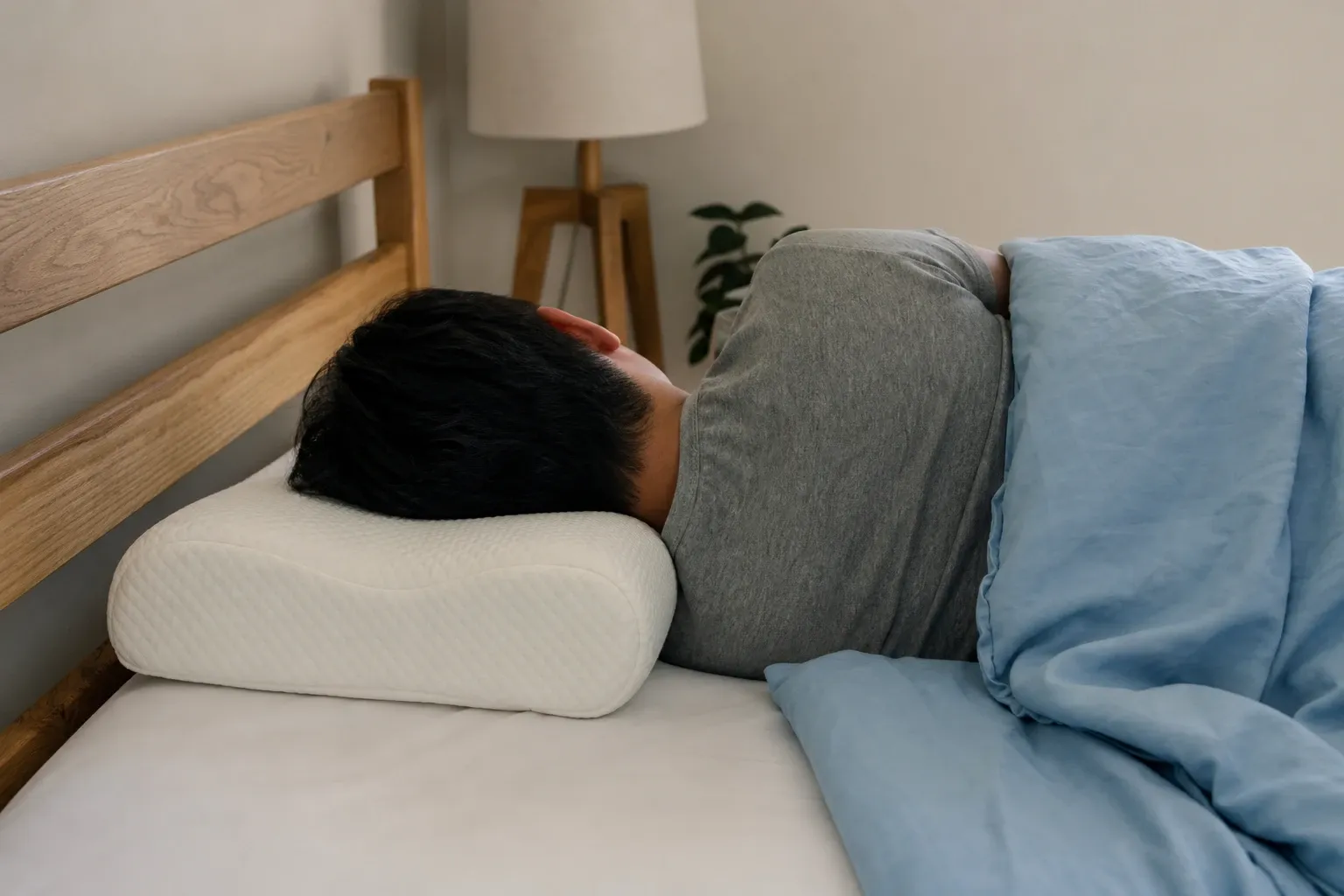
Which cervical pillow should a side sleeper pick?
A side sleeper should pick the cervical pillow whose height matches their shoulder gap and mattress, then choose the fill they like. That’s the whole game. Brand matters less than fit, because fit depends on your sleeping position, shoulder width and how firm your mattress is.
A pillow is a comfort product. It can make side sleeping more comfortable, but it’s not a substitute for medical care. Some pillow designs may ease neck pain, but the findings are mixed, and nothing published shows a benefit for Derila Ergo.
Quick picks by body type and mattress
Derila Ergo is our top pick for side and back sleepers who want a contoured memory foam shape at a fair price per pillow.
Our top pick: Derila Ergo
- Contoured shape for side and back sleepers. It’s a memory foam pillow with front support wings, and the maker says the contour is shaped to support the neck.
- A clear, mid-range height. It measures 54 x 36 x 12 cm (21.2 x 14.1 x 4.7 in), which lands in the range many average-shouldered side sleepers need.
- Price per pillow drops in packs, with a 60-day return window. It’s $59.99 for one, and the two-pack works out to $49.99 per pillow.
Check the current Derila Ergo price and the return terms on the official site.
See Derila Ergo on the official site60-day money-back guarantee
The other options here are pillow types rather than brands:
- Adjustable shredded foam: best if you need to fine-tune height, or your shoulders are very broad or very narrow.
- Latex: best for side sleepers who want firm, springy support that doesn’t sink much.
- Down or down alternative: best for lighter people with narrow shoulders who like a soft feel.
- Buckwheat: best for hot sleepers who want a firm pillow they can shape by hand.
How we judged the options
We judged each cervical pillow for side sleepers on six things that change how it feels night to night.
- Height match. Can it fill your shoulder gap?
- Firmness. Does it hold your head up, or sink flat by morning?
- Contour shape. Does it have a curve or wings to support the neck and leave shoulder room?
- Cooling. Does the fill or cover breathe?
- Price per pillow. Worked out from the published pack price.
- Return terms. How long you have, and what the return costs you.
How high should a side sleeper’s pillow be? A shoulder-width fit guide
A side sleeper’s pillow should be about as high as the distance from the side of the neck to the outer edge of the shoulder, usually 3 to 6 inches. That distance is your shoulder gap, and it’s your target for the pillow’s height (its loft).
Research backs the idea that height matters. A small lab study of 9 healthy side sleepers found that the best pillow height depended on each person’s shoulder width, and a medium height with neck support kept the neck curve closest to how it sits when standing. Another small study of 21 adults linked a middle-height foam pillow to the most comfort, while the lowest pillow was least comfortable. For more detail, see our guide to the best pillow height for side sleepers.
Measure your shoulder gap in inches
You can measure your shoulder gap in a minute with a tape measure and a helper.
- Stand straight with your arms relaxed.
- Have someone measure from the side of your neck, just below the ear, straight out to the outer edge of your shoulder.
- Write the number down in inches. That’s your starting loft.
Quick tip: No helper? Stand sideways to a wall with your shoulder touching it, and measure from the wall to the side of your neck.
Height by shoulder width
Shoulder width is the biggest single clue to the pillow height a side sleeper needs. Use these ranges as a starting point, not a rule.
| Shoulder width | Example | Firm mattress | Medium mattress | Soft mattress |
|---|---|---|---|---|
| Narrow | Petite frame, gap under 4 in | About 4 in | About 3.5 in | About 3 in |
| Average | Gap around 4-5 in | About 5 in | About 4.5 in | About 4 in |
| Broad | Wide shoulders, gap over 5 in | About 6 in | About 5.5 in | About 5 in |
A side sleeper with wide shoulders on a firm mattress sits at the top of the chart. A petite sleeper on a plush topper sits at the bottom.
Adjust for mattress firmness
Mattress firmness changes the height you need because a soft mattress lets your shoulder sink in. On a soft bed, go a little lower. On a firm bed, your shoulder stays up, so go a little higher.
Check the result in a mirror or with a photo from behind. Your nose should line up with the middle of your chest, and your neck should look level with your spine (good cervical alignment, meaning your neck keeps its natural curve). If your head tips up, the pillow is too tall. If it droops, it’s too low.
Do cervical pillows work for side sleepers?
Cervical pillows can make side sleeping more comfortable for some people, but the research is modest and fit matters more than the label. A cervical pillow is simply one shaped with a raised curve to sit under the neck.
A 2021 review of 35 papers found that pillow shape and height seemed to affect neck alignment in side-lying more than the fill material. A smaller 2025 review of five studies in people with long-term neck pain found limited evidence for pillows as an add-on to care, with no single type, whether latex, foam or standard, clearly better. So: get the height right first, then pick the feel you like.
What contour shapes are made to do
Contour shapes are made to fill the space under the neck while giving the head a lower spot to rest in. Wings or cut-outs at the front aim to leave room for the shoulder and arm.
The point is pressure relief: spreading your weight so the ear, jaw and shoulder don’t take all of it. Think of a well-fitted shoe. It isn’t softer everywhere, it’s just shaped where your foot is.
What research can and cannot say
Research on pillows tends to use small groups, different pillow designs and short time frames. That makes it hard to name one best design for everyone.
What it does suggest is steady: height and shape count. No single pillow model suits everyone. If you have neck problems, ask your doctor or physical therapist what height and shape suits your body.
Cervical pillow types compared for side sleeping
Contour memory foam suits most side and back sleepers who want steady support, while shredded foam suits anyone who needs to adjust the height. Here’s how each option stacks up.
| Product or type | Type and size | Loft and firmness | Cover | Price per pillow | Return terms |
|---|---|---|---|---|---|
| Derila Ergo | Contoured memory foam with front support wings; 54 x 36 x 12 cm (21.2 x 14.1 x 4.7 in) | 12 cm (4.7 in); firmness not stated | Removable, zippered, machine wash warm; maker calls it a cooling cover | $59.99 (1 pillow); $49.99 in the 2-pack ($99.98); $37.49 in the family pack ($149.96 for 4) | 60 days from receiving the order; item in manufacturer’s condition and original, undamaged packaging; buyer ships it back; shipping costs not refunded |
| Adjustable shredded foam | Loose foam pieces; sizes vary | Adjustable by adding or removing fill; medium feel | Varies by brand | Varies by brand | Check the seller |
| Latex | Solid or contoured latex; sizes vary | Medium to tall; firm and springy | Varies by brand | Varies by brand | Check the seller |
| Down / down alternative | Fluffy fill; sizes vary | Soft; compresses with use | Varies by brand | Varies by brand | Check the seller |
| Buckwheat | Hull-filled; sizes vary | Adjustable; very firm | Varies by brand | Varies by brand | Check the seller |
Prices were checked on the official site on November 4, 2026, and they change often.
Contour memory foam
Contour memory foam is a slow-sinking foam molded into a neck curve, and it suits side and back sleepers who want the same shape every night. Derila Ergo is our pick in this group.
Pros
- Holds its shape; no fluffing
- A curve for the neck and room for the shoulder
- Cover usually removes for washing
Cons
- Height is fixed
- Can feel warm for some
Care: Wash the cover; spot-clean the foam and let it air-dry. Don’t put foam in a washer.
Adjustable shredded foam
Adjustable shredded foam lets you add or remove pieces to set the exact height. It’s the best fit for very broad or very narrow shoulders.
Pros
- Height you can tune
- Shapes around the shoulder
Cons
- Takes trial and error
- Fill shifts and needs shaking
Care: Most covers wash; check the label before washing the fill.
Latex
Latex is a springy foam that pushes back quickly, so it suits side sleepers who don’t like sinking in. The 2021 review found rubber (latex) pillows helped neck pain in some trials of people with long-term neck pain.
Pros
- Firm, bouncy support
- Tends to sleep cooler than dense foam
Cons
- Not for anyone with a latex allergy
- Often heavy and pricier
Care: Spot-clean; keep out of direct sun.
Down and down alternative
Down and down alternative pillows are soft and squashy, best for light sleepers with narrow shoulders. Down alternative is a synthetic fiber that mimics feathers.
Pros
- Soft, cozy feel
- Easy to scrunch
Cons
- Flattens through the night
- Often too low for wide shoulders
Care: Many are machine washable; dry fully to prevent clumps.
Buckwheat and gel
Buckwheat pillows are filled with hulls that shift into shape and let air through, which suits hot sleepers. Gel layers on foam pillows also aim to feel cooler.
Pros
- Firm and adjustable (buckwheat)
- Breathes well
Cons
- Noisy and heavy (buckwheat)
- Gel’s cooling feel can fade as it warms
Care: Remove hulls before washing the case; air the hulls in sun.
Derila Ergo for side sleepers: shape, price and return terms
Derila Ergo is a contoured memory foam pillow with front support wings, a mid-range 4.7-inch height and a 60-day return window. It suits side and back sleepers with average shoulders.
What it is
Derila Ergo is sold online by UAB Domestica, and it ships vacuum-packed. We’re an independent site, not the vendor. After unpacking, leave it 6-8 hours to expand.
The maker says the memory foam contours to your natural shape and the cover and breathable foam help keep it cool and dry. The maker also calls the materials hypoallergenic. The maker hasn’t published a study of Derila Ergo itself.
Side sleepers rest the front curve against the side of the neck and keep the pillow right side up, facing them. For setup tips, see how to use a cervical pillow, and for the full rundown read our ergo memory foam pillow review.
Price per pillow:
- 1 pillow: $59.99
- 2 pillows: $99.98, or $49.99 each
- Family pack, 3+1 free: $149.96, or $37.49 each
Return terms: The maker advertises a 60-day guarantee. You have 60 days from receiving the order. Fill in the contact form, wait up to 3 business days for the RMA number and address, then ship it back with tracking. Non-defective items must come back in manufacturer’s condition, in original, undamaged packaging. You pay to ship it back, and shipping costs aren’t refunded. The refund is issued within 14 days of the parcel being received and inspected.
Quick tip: Keep the box and packaging until you’re sure, since the return needs them.
Who should skip it
Skip Derila Ergo if its fixed 4.7-inch height doesn’t match your shoulder gap.
- You need adjustable loft, or very tall or very low height
- You love the sink-in softness of down
- You sleep mostly on your stomach
- You don’t want to pay return shipping if it doesn’t suit you
Check your shoulder measurement against the 4.7-inch height, then see today’s pack prices.
See Derila Ergo on the official site60-day money-back guarantee
Best pillow for neck and shoulder pain at night
The best pillow for neck and shoulder discomfort at night keeps your shoulder from being pushed up and your head from dropping. That usually means a medium-firm pillow at your measured height.
A few habits help too:
- Hug a body pillow in front. It rests your top arm so that shoulder doesn’t roll forward.
- Check your mattress. A mattress that’s too firm jams the bottom shoulder; one that’s too soft lets your hips sag. It can matter as much as the pillow.
- Tuck your bottom shoulder slightly forward so you’re not lying right on the joint.
For example, a side sleeper with wide shoulders on a firm mattress who wakes with a sore top shoulder might try a taller pillow plus a body pillow to hug.
On snoring: side sleeping is a comfort choice. If a doctor says your snoring is worse on your back, side sleeping can help some people, and a comfortable pillow can make side sleeping easier. A pillow isn’t a treatment for snoring.
How long to adjust to a new pillow, mistakes to avoid and when to see a doctor
A contour shape can feel odd at first if you’re used to a flat one.
Adjustment and replacement
Give a new cervical pillow some time before you judge it. A 60-day return window leaves room to do that.
Replace a foam pillow when it stays flattened or no longer springs back or supports you well. Down and fiber pillows tend to wear out sooner.
Common buying mistakes
A pillow that’s too tall can tip your head out of neutral alignment.
- Picking height without measuring your shoulder gap
- Ignoring your mattress firmness
- Buying on firmness alone
- Skipping the return terms, including who pays return shipping
When a pillow is not the answer
See a doctor before shopping if you have neck pain that lasts more than a week or two or spreads into an arm, or numbness, tingling, weakness or headaches. The same goes for pain after an injury. MedlinePlus explains when neck pain needs a doctor.
Loud snoring with gasping or pauses in breathing also needs a doctor; the NHLBI lists signs of sleep apnea to bring up. A doctor or physical therapist can help with lasting problems.
Never put a pillow in a baby’s sleep space. Safe to Sleep guidance says to keep the sleep area bare.
Where this fits in our cervical pillow guides
This page focuses on side sleepers and shoulder fit. If you also sleep on your back or want more shapes to compare, see our roundup of the best cervical pillow options for every position.
Not sold on a cervical shape? Our guide to the best side pillow for side sleepers covers standard and adjustable pillows. For position, mattress and care basics, start at our healthy sleep pillows hub.
Our pick for most side sleepers
Derila Ergo is our pick for most side and back sleepers with average shoulders who want a contoured memory foam shape. Its 4.7-inch height fits a common shoulder gap, the per-pillow price falls to $49.99 in the two-pack, and you get 60 days to return it in its original condition.
If your shoulders are very broad or narrow, or you like to fine-tune height, an adjustable shredded-foam pillow is the better fit. Measure your shoulder gap first, then check the price and return terms.
See Derila Ergo on the official site60-day money-back guarantee
Questions readers ask
How do I know if my pillow is too high for side sleeping?
A side-sleeping pillow is too high if your head tilts up toward the ceiling, your bottom ear feels squeezed, or the top side of your neck feels stretched in the morning. Have someone check from behind: your nose should line up with the middle of your chest. If it points upward, go lower.
Can I use a cervical pillow if I switch between back and side?
Yes, many combination sleepers use a contour cervical pillow. Back sleeping usually needs a lower height than side sleeping, so some contour pillows have a lower and a higher edge. Pick one sized for your side-sleeping height, and rotate it so the lower curve sits under your neck when you roll onto your back.
Should I put a pillow between my knees as a side sleeper?
A pillow between the knees helps many side sleepers feel more comfortable. It keeps the top leg from dropping forward and twisting the hips and lower back. Choose one firm enough to keep your knees about hip-width apart. A full body pillow can do the same job and rest your top arm.