We may earn a commission if you buy through links on this page, at no extra cost to you. How this works
Derila Ergo: A contoured memory foam pillow with side wings and a removable, machine-washable cover.
See Derila Ergo on the official site60-day money-back guarantee

Start here
The fastest way to a better pillow is to start with how you sleep, then fine-tune height and firmness. Pick the guide that matches you:
- A simple method for how to choose a pillow: measure, test and decide in a few steps.
- The best side pillow for side sleepers: taller, firmer options that fill the shoulder gap.
- Our pick of the best pillow for back sleepers: medium height with a gentle neck curve.
- Why you might have a stiff neck pain after sleeping: common causes and simple first steps.
- Our review of one ergo memory foam pillow: who the Derila Ergo suits and who should skip it.
Do neck pillows really work?
A neck pillow can help many people sleep more comfortably when its height and shape fit them, but research on fixing pain is limited and mixed. Fit matters more than the label.
What a neck pillow can and cannot do
A neck pillow can hold your head at a comfortable angle so your neck muscles aren’t straining all night. That’s the whole job. It can’t undo a bad mattress, daytime desk posture or stress, which all play a part in how your neck feels.
The research is honest about this. A 2021 review of 35 studies found rubber (latex) and spring pillows were linked to less neck pain and waking symptoms in people with chronic neck pain, but pillow design didn’t change sleep quality, and the effects were modest. That same review suggests pillow shape and height matter most for neck position on your side.
Other studies point different ways. A 2009 study of 106 side sleepers found a latex pillow beat people’s own pillows, while a foam contour pillow showed no clear edge over regular shapes. So when a maker promises relief from neck pain or better sleep, read that as a claim. Pillows can add comfort, but results vary from person to person.
How long to use one before judging it
Give a new pillow one to four weeks before you decide. Your neck is used to your old pillow, so a little stiffness in the first nights can just be adjusting. Sharp pain, or pain that gets worse each morning, isn’t break-in. Stop using that pillow.
Quick tip: Keep a one-line note each morning (“neck fine,” “a bit stiff”). After two weeks you’ll see a trend instead of guessing.
Which pillow suits how I sleep?
Your main sleeping position decides the right pillow height (its loft) more than anything else. Start there, then adjust for your body and taste.
Side sleepers
Side sleepers need the tallest, firmest pillow, one that fills the gap between ear and shoulder so your head sits level. A side sleeper with wide shoulders needs more height than a slim one. A small lab study of nine people found the best pillow height for side sleepers tracked shoulder width, and a medium height with neck support kept the neck closest to its natural standing curve.
Ergonomic pillows can work well for side sleepers if the taller edge matches that ear-to-shoulder gap.
Back sleepers
Back sleepers do best with a medium-height pillow that supports the curve of the neck without pushing the chin toward the chest. If you look straight up at the ceiling while lying down, the height is about right. A contoured design with a low dip for the head often suits back sleepers.
Stomach sleepers
Stomach sleepers need a very thin, soft pillow, or none at all. A tall pillow twists the neck further back. If you’d like to switch positions, try it slowly, for example by hugging a body pillow on your side.
Combination sleepers
Combination sleepers, who roll between positions, need a middle height and a shape that works on both side and back. Many people like a pillow with a slightly taller edge on one side, so you can turn it when you roll.
Quick tip: Measure from the base of your neck to the outer edge of your shoulder. That number is a rough guide to the pillow height a side sleeper needs.
Quiz: which kind of pillow should I look at first?
This short quiz points you to a pillow shape, height and filling to look at first, based on how you sleep and how you wake up. It’s a starting point, not a diagnosis.
If your result points to a contoured memory foam shape, the Derila Ergo is one option to look at, with a 60-day return window you can read before buying.
See the current price and return terms on the official site.
See Derila Ergo on the official site60-day money-back guarantee
Contour, roll, horseshoe or flat: what are the neck pillow types?
Neck pillows come in four main shapes: contour, roll, horseshoe and flat. Each one suits different positions and uses.
| Shape | Best position | Typical firmness | Typical drawback |
|---|---|---|---|
| Contour (cervical) | Side, back | Medium to firm | Can feel too high for small frames or stomach sleepers |
| Roll-shaped | Back | Firm | Supports only the neck; head may feel unsupported |
| Horseshoe-shaped (travel size) | Sitting upright | Soft to medium | Not made for lying in bed |
| Flat, regular | Stomach, some back | Soft to medium | Little cervical support for side sleepers |
Contour and cervical memory foam
A contour pillow, often called a cervical pillow, has a raised edge for the neck and a lower dip for the head. This cervical support (holding the neck’s natural curve) is what most ergonomic pillows are built around. For direction: the higher curve goes under your neck, the lower dip under your head. Side sleepers turn the taller edge toward the shoulder.
Roll and horseshoe shapes
A roll-shaped pillow is a firm cylinder that sits under the neck, often tucked inside a pillowcase with a flat pillow. Horseshoe-shaped pillows wrap around the neck and are mostly used upright.
Travel neck pillows
Travel neck pillows are for sitting up on planes, trains and car rides, not a swap for your bed pillow. A good one offers some chin support so your head doesn’t drop forward as you doze. Think of it like a seatbelt for your head: helpful in the seat, pointless in bed.
What is it made of? Memory foam, latex, and other fillings
Pillow filling decides how a pillow feels, how warm it sleeps and how long it lasts. Memory foam and latex are the most common in neck pillows.
Memory foam
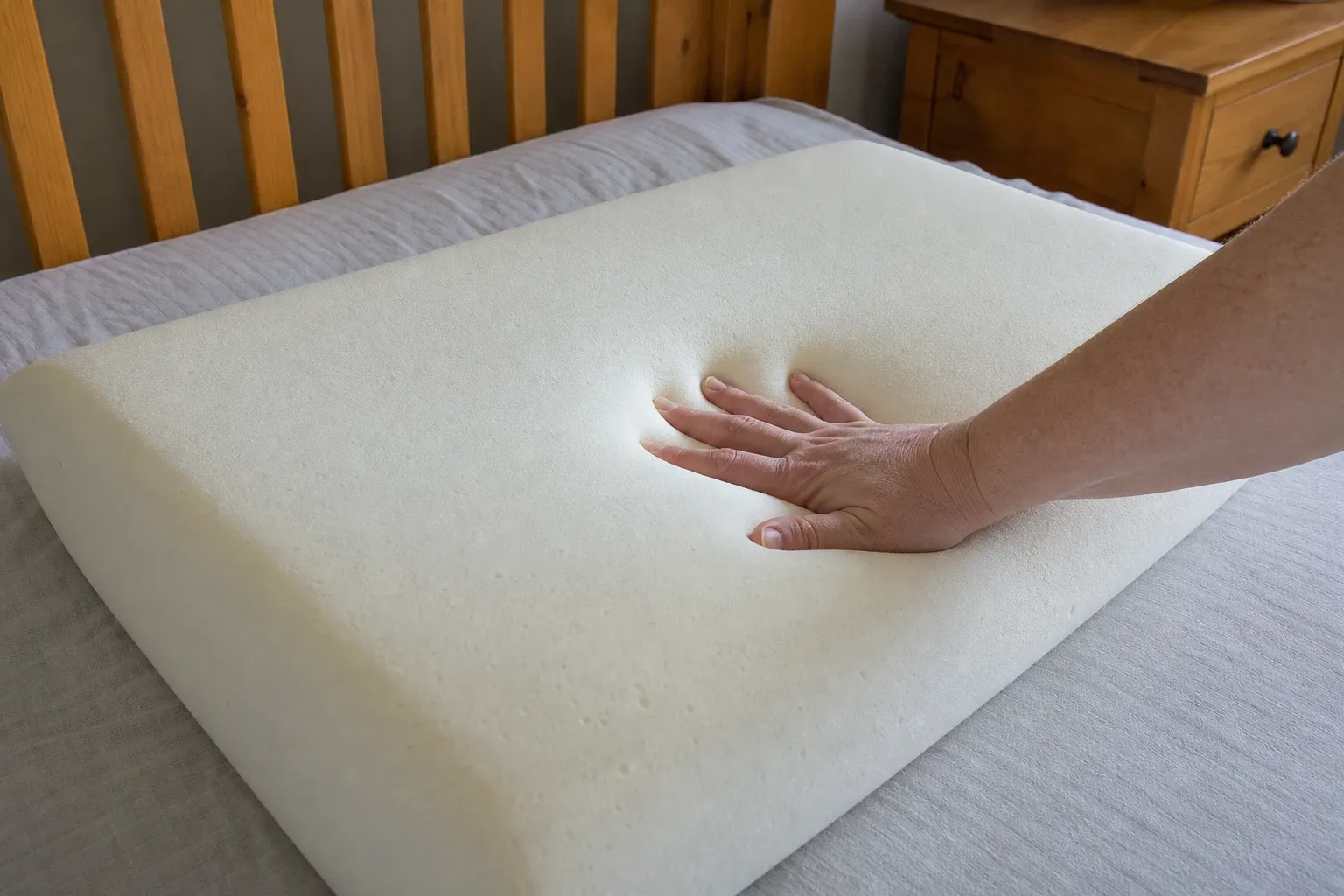
Memory foam slowly sinks and molds to your head and neck, then springs back. It feels steady and has little bounce. It can sleep warm, which is why many makers add cooling covers. Claims like “cooling” or “hypoallergenic” usually mean a breathable fabric or a fill that collects fewer dust mites, but how much they help varies.
Latex, microbead, flaxseed and millet hulls
Latex feels springier than memory foam and stays cooler; it’s the “rubber” pillow that did well in some studies. Microbead pillows are light and squishy, good for travel. Flaxseed and millet hulls are heavy and shift to shape, and they can rustle when you move.
Water-filled and inflatable
Water-filled pillows let you change firmness by adding or removing water. Inflatable ones pack tiny and suit camping or travel, though some people find them bouncy.
Care tips that fit most pillows:
- Choose a removable washable cover and wash it every few weeks.
- Don’t put memory foam or latex cores in the washer; spot clean and air them out.
- Replace a pillow if it has lumps, flat spots, a smell that won’t go away, or you keep waking sore.
How do I know a pillow is wrong for me?
A pillow is wrong for you when you keep waking with a stiff neck, a numb arm or a headache, or when your head sits at an odd angle.
Signs to switch pillows
- Your chin tucks toward your chest, or your head tilts up or down.
- You wake stiff or sore most mornings.
- You often wake hot and sweaty.
- It feels too firm or too tall, so you push it away in the night.
For example, a side sleeper with narrow shoulders on a tall contour pillow may find their head tipped toward the ceiling. A lower pillow often fixes that.
Break-in or a bad fit?
Break-in feels like mild, fading stiffness over the first week or two. A bad fit stays the same or gets worse. Price and star ratings tell you little about fit, so look for a fair return window or trial period before you buy.
Are neck pillows safe for kids?
Adult neck pillows aren’t made for young children, and babies should sleep with no pillow at all. The Safe to Sleep campaign advises keeping pillows out of a baby’s sleep area.
For older children, ask a pediatrician before using a firm or cervical pillow. If one is advised, a small, soft, low pillow is usually the safer pick.
Who this is not for, and when to see a doctor instead
A pillow isn’t the answer for lasting neck pain, nerve symptoms or breathing problems during sleep. Those need a doctor.
See a doctor if your neck pain:
- lasts more than a week or keeps coming back over weeks
- started after a fall or injury, or comes with fever
- comes with numbness, tingling or weakness in an arm or hand
MedlinePlus explains common causes of neck pain and when to contact a doctor.
Loud snoring, gasping in your sleep or heavy daytime sleepiness can be signs of sleep apnea. The NHLBI lists these symptoms as reasons to talk to a doctor. A pillow doesn’t treat snoring or sleep apnea, and it never replaces a sleep study or prescribed treatment.
Where does our contoured memory foam pillow fit in?
The Derila Ergo is a contoured memory foam pillow with front support wings, sold online by UAB Domestica, and it’s one option for side and back sleepers who like a defined contour.
What the maker says:
- Memory foam core that contours to your shape, with front “wings” said to support the neck and jaw.
- A removable, zippered, machine-washable cooling cover said to help keep it cool and dry.
- Materials described as hypoallergenic.
- Standard size 54 x 36 x 12 cm (about 4.7 in tall). It ships vacuum-packed and needs 6 to 8 hours to expand.
The maker hasn’t published a study of Derila Ergo itself, so its comfort claims are the maker’s own.
Who it may suit: side sleepers with average shoulders and back sleepers who want a firm, shaped pillow.
Who may prefer something else: stomach sleepers who need a very thin pillow, and anyone who loves a soft, fluffy feel.
Price on the page we checked: $59.99 for one pillow, $99.98 for two, and $149.96 for a 3+1 family pack (four pillows). Prices were checked on the official site on November 4, 2026, and they change often. The vendor advertises a 60-day return policy: fill in the contact form within 60 days, get an RMA number, and send the pillow back in its original, undamaged packaging with tracking. Shipping costs aren’t refunded, and refunds come within 14 days of inspection. Buy only from the official site.
Check the current Derila Ergo price and the return terms on the official site.
See Derila Ergo on the official site60-day money-back guarantee
Whatever you choose, match the height to how you sleep, give it a couple of weeks, and see a doctor if pain lingers or comes with numbness or tingling.
Every guide on this site
Best pillows
- Derila Ergo review
- Derila Ergo vs others
- For side sleepers
- For back sleepers
- For combination sleepers
- Side sleepers with neck discomfort
- Sore neck and shoulders
- Pillows for neck pain
Pillow types
- Cervical pillows
- Cervical for side sleepers
- Contour pillows
- Memory foam pillows
- Memory foam for neck discomfort
- Latex for side sleepers
- Adjustable loft pillows
- Cooling pillows
- Orthopedic pillows
- Wedge pillows
Choosing a pillow
- How to choose a pillow
- Pillow height for side sleepers
- Pillow firmness for side sleepers
- What is a cervical pillow?
- Hypoallergenic pillows
- When to replace a pillow
- How to clean pillows
Sleeping positions
- Best position for neck comfort
- Sleeping on your back
- Stomach sleeping
- Left or right side?
- Knee and body pillows
Neck comfort
Questions readers ask
How often should I replace a neck pillow?
Most neck pillows last one to three years, with memory foam and latex usually lasting longer than polyester. Replace yours sooner if it has lumps, flat spots, a smell that won’t wash out, or you keep waking stiff. Washing the cover often helps the pillow stay fresh longer.
Can I use a neck pillow with a regular pillow?
You can, but stacking often makes the height too tall and tips your head forward. A small roll pillow tucked into the case of a flat pillow works for some back sleepers. If you stack, check that your head still sits level and your chin isn’t pushed down.
Is a firmer pillow better for neck support?
Not always. Firmness should match your position: side sleepers usually need firmer support to fill the shoulder gap, back sleepers do well with medium, and stomach sleepers need soft and thin. A pillow that’s too firm can push your head up and strain your neck instead.
Can I travel with my bed pillow instead of a travel neck pillow?
Yes, if you have room, and it’s often better for hotel beds. For sitting upright on a plane or in a car, a travel neck pillow with chin support works better, because a bed pillow doesn’t keep your head from tipping forward while you sit.
Do cooling covers really keep a pillow cool?
Cooling covers usually use breathable or smooth fabrics that feel cool at first and let some heat escape. They can help, but memory foam underneath still holds warmth. If you run hot, latex or a more open filling may suit you better than relying on the cover alone.